There must be more than this Provincial life
Oxford defines provincial as
Quick note about which dictionary to rely on when studying vocabulary for standardized tests: it doesn’t matter.
That said, we have found that the College Board’s use of their “vocabulary” words in test questions has almost always mapped perfectly onto the definition and example found within the New Oxford American Dictionary—usually the secondary definition of the word.

It’s not that the first, more literal dictionary definition—the denotation—is not also represented on the test. It shows up, but it’s not really being “tested” when it shows up, like in the example below:

Unlike in that problem, however, even when using the word province, the College Board will often opt for a more abstract, connotative use of the word, like in the example below:
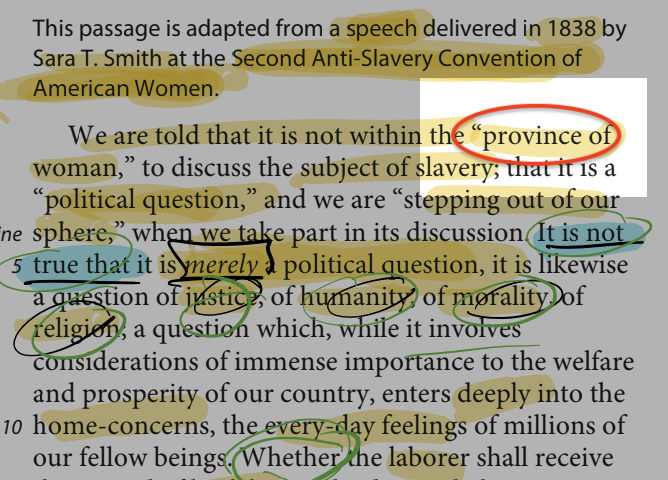
In this case, the phrase “province of” means the “domain of” or perhaps the “sphere of influence of.” In this sense, province is a region of control.
So provincial is one of those words that can prop something up—the decision would be up to the provincial governors—or take something don a peg—the decision was stalled by the provincial concerns of the local chiefs.
Disney® defines provincial as…
Think back to the “Bonjour!” song at the beginning of Beauty and the Beast. To help you remember, we’ve included a GIF of the movie moment below. You’ll have to click the line from the song to see it. Sorry for that inconvenience, but only provincial bloggers would inappropriately harass their readers’ eyes with fast-looping GIFs.
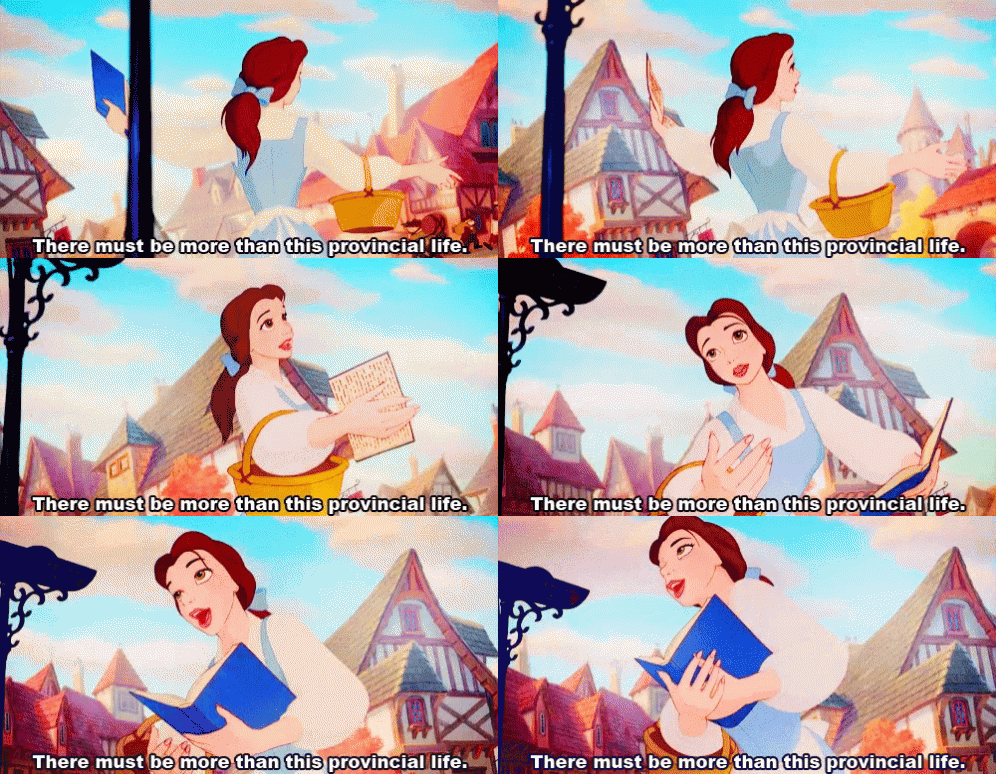
What’s that? My use of the word provincial in that last paragraph was too loose for you? Hush. Let’s get back to our explication of children’s movie music.
There goes the baker with his tray, like always
The same old bread and rolls to sell
Ev’ry morning just the same
Since the morning that we came
to this poor provincial town
Belle (“Little Town”) by Paige O’Hara and Richard White
Belle wants to see the world. To do so, she must get out of “this poor provincial town.” Or, she could just read a ton of stories in books—which is what she opts to do.
Belle’s complaint of her town in the lyrics above evokes some other historically tested vocabulary words—all of which more or less mean commonplace, dull, and boring:
- Banal
- Hackneyed
- Humdrum
- Insipid
- Mundane
- Pedestrian
- Prosaic
- Quotidien
- Timeworn
- Trite
But anyway, back to provincial, which is quite different from those. We find that sometimes learning the antonyms of a word can help understand its deeper usages. Here are some words, for example, that mean the opposite of provincial:
- Citified (for real)
- Cosmopolitan
- Metropolitan
- Sophisticated
- Worldly
- Well-traveled
Answer choice C in the question below, whatever passage it’s a part of, is using the word provincial in the typical manner in which the College Board will.

Stay tuned for more posts in our ‘Words of the Week’ series!
Until then, you can find more informative posts here! If you found this helpful, please share it with someone who may find this information useful as well.