

Formulas are for Mules, Part III
Wait! Did you read Part 2 of this series? Click here to read now.
A hopefully unnecessary disclaimer
If you haven’t noticed yet, my modus operandi (my MO, for you true crime fans) in annihilating your dependence upon formulas has never involved claiming that a formula you learned in school isn’t true. Of course they’re all true. Scholastic institutions and curriculum developers over centuries the world over wouldn’t get away with teaching young people formulas that aren’t true.
In fact, my rigorously outlined claim in Part II is that formulas—more specifically, functions with stored operations relying on abstract variables—are perfect tools for computer programs (and remember who computers work for, at least for the time being).
My thesis, rather, is that formulas are not useful on test day—you know, when you’re under immense pressure to recall and perform several operations in what most people consider to be “way less than enough time” to recall and perform such operations.
So please, when you read what follows, do not take my general tone of irreverence to imply that I don’t think Archimedes was an awesome dude to have utilized Euclidean earth measurement (you know, “geo-metry”) to derive the circumference and area of circles circa 200 BC.

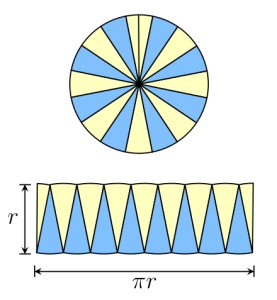
Rather, I’d like to share what I’ve learned to be most useful on test day from my experience working privately with thousands of young people.
Show your faces, bad boys
Come on out; don’t be shy. I know you’re scared that I’m going to ridicule you, but we have to show the audience that their teachers weren’t liars. So here they come, in all their glory, “two pi R” and “Pi R squared.”
Drum roll? Red carpet? Nah, let’s hold off on any superfluous fanfare. Just let ’em strut on out.
Circumference Formula

Area Formula

Well, those aren’t so bad
Before you find yourself uttering such foolishness as, “Well, those aren’t so bad; just leave the teachers and those diligent students alone,” please, let me be clear: I wouldn’t have such a problem unless I had seen firsthand the detrimental results of young people trying to recall exactly those two formulas.
In my early years of tutoring, when I first met new students, I would invariably ask them to recall and recite the Circumference formula. For many, of course, a blank stare would follow, at which point I would alleviate their concerns by letting them know that (1) they’re not alone and (2) we would soon rectify the issue. But I have seriously crunched the numbers, and, for most students I would meet, after some initial fumbling around in their brains, they would exuberantly spout the following Frankensteinian monstrosity:
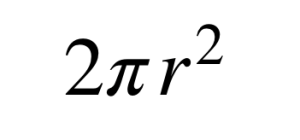
If you scroll up just a half tick, you’ll quickly realize that poor Sally Student had of course learned the right formulas at some point or another; however, due to general disuse of those formulas, combined with the stress of meeting a new human with some academic authority—which pales in comparison to the stress of test day, by the way—she just ever so slightly fritzed out and combined the two real formulas. Can’t blame her.
Why do we put the π in the middle of one formula while putting π at the front of another formula?
That’s a great question. And although it has a true and mathematically accurate answer, I’ll save that for another time that carries more pedagogical purpose. For now, I’m simply trying to make your life easier by putting π “in his place”—that is, in the back, where he belongs.
When students are to answer questions about circumferences and areas of circles, their answers are mandated to be in the form 10π, 18π, 64π, etc. Yet, when those same students are initially provided a radius (the r in the formulas, of course), they are instructed to use those silly formulas that place the π in the middle or the front.
Time for an example
Let’s imagine a prototypical “easy” circle problem on a math test:
What is the circumference of a circle whose radius is 5 centimeters?
What’s the circumference of a circle with radius of 5, eh?
Okay, okay… let’s see… “two pi R squared”—NO, no, that’s not right. Hang on… alright, I’ve got this… okay… “two pi R,” yeah, that’s it. Alright, let’s do it:
2 x π x 5 …. Okay, so now lemme just multiply that two and five… Wait, do I bring the two over to the right with the five, or do I bring the five over to the left with the two? Oh, right, it doesn’t matter, and I’m utterly wasting time. Just say ten. “10,” uh, “π” or whatever. 10π !!
Wow, was that tedious. Well, after too many years of witnessing young people have that kind of experience (not to mention sharing in that experience myself), I started mandating a different kind of protocol when it comes to circles.
A different kind of protocol
When you get a radius (r), double it, square it, and don’t forget to say “pi” each time. In fact, if you remove π from each formula, you’re left with the following:
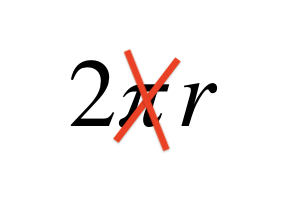

That’s right, a double and a square, hiding in plain sight the whole time.
Try it yourself, with a little call and response, although it’s even more fun when a third party provides the radiuses radii.
| Radius | 5 | 6 | 7 | 8 | 12 |
|---|---|---|---|---|---|
| Circumference (double the radius!) | 10π | 12π | 14π | ? | ? |
| Area (square the radius!) | 25π | 36π | 49π | ?? | ?? |
It’s worth mentioning that circumference is merely a one-dimensional (1D) length, hence the mere doubling. And the surface area of any two-dimensional (2D) shape in the universe can only be measured in square units—so that’s a nice way to remember which is the one that gets “squared.”
Check back soon for a video summary of everything covered in this series. It is guaranteed to be entertainingly redundant—in a useful way, of course.
Stop working too hard. Good luck on your test!
Why weren’t we all taught the easy way?!
Mark with reveal even more things you shouldn’t have been taught in the next part of this series. While you wait, you can check out our other free posts. Please share this post with someone who may find it useful!