
Reading (on the Reading Section) Is for Losers
I have an English degree. I taught English/Language Arts for six years in the classroom. I read, on average, over a book per week. But on the Reading sections of standardized tests, I don’t read the passages.
Sounds silly, right?
Is it sillier than wasting time reading a whole passage when (1) you’re not going to be asked questions about the information in approximately one-third of the passage and (2) you’re going to forget the details of what you’re reading by the time you get to the questions?
If you think you can fully digest four, single-page passages and answer ten questions about each in thirty-five minutes for the ACT or digest five, page-and-a-half passages and answer 10-11 questions about each in sixty-five minutes, I think you’re pretty silly. So there.
So if I’m not reading, how do I get my perfect scores?
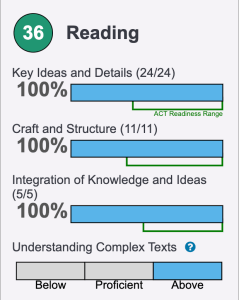
I skim. Most of the time.
I always start off with the intention of skimming every passage, but, especially by the time I get to the last passage of a Reading section, I’m ready to be done with the test. When that happens, I just skip straight to the questions. I can get away with that because I’ve been doing this for so long—but many students can’t.
My skimming strategy throughout the ACT is to read the first sentence—or two sentences, rarely—of most paragraphs to get a general idea for what the passage is about. If I can connect the main ideas of paragraphs together, great! If I can’t, I don’t stress!
On the SAT, for the science passages, I’m looking for a particular structure that most passages use. If it’s not there—or I’m on the narrative or historical document passage—I’ll revert back to my ACT strategy.
I just want a baseline understanding of the main idea of the passage as well as a map of it. Then, I get to the questions as fast as possible.
Because the ACT/SAT are standardized, multiple-choice tests, they can only ask surface-level questions about a text. They will do their best to mask this fact, but it’s embarrassingly true. If they were to ask questions about deeper meanings in a passage, they would open the passage up to interpretation. In that case, there would be the possibility of more than one correct answer.
As Mark makes expressly clear in his Keep Your Paradigm Straight, Part I and Keep Your Paradigm Straight, Part II, the test maker never gives you more than one correct answer.
Rest assured: the test makers are infallible. I have blind faith that the answer to every question must be stated in the text. It’s my job to find that answer within the time limit. I’ll have more time to find those answers if I don’t waste time struggling through the whole passage first.
This skimming strategy, like every strategy on these tests, takes practice. The first time you practice skimming, don’t despair if you miss more questions than you did when you read the whole passage. You just need to retrain your brain.
I will also say that I have, in all my years as a tutor, met fewer than ten students who made reading the whole passage work as a viable strategy. They were able to read the whole passage once—spending several minutes doing so—and then answer all the questions, only returning to the passage once or twice to confirm some details. If you’re a regular Encyclopedia Brown, go for it. For the other 99% of us, skimming is the way to take your Reading score to the highest level without using up energy that you could put into the other test sections.
In a future post, I’ll ramble on about my mindset when answering questions (hint: keep it literal and word search). KYBO Club members can watch videos of me skimming through and answering questions on this very website.
Ready for the next post in this series?
Head right over to Part 2! If you found this helpful, please share it with someone who may find this information useful as well.