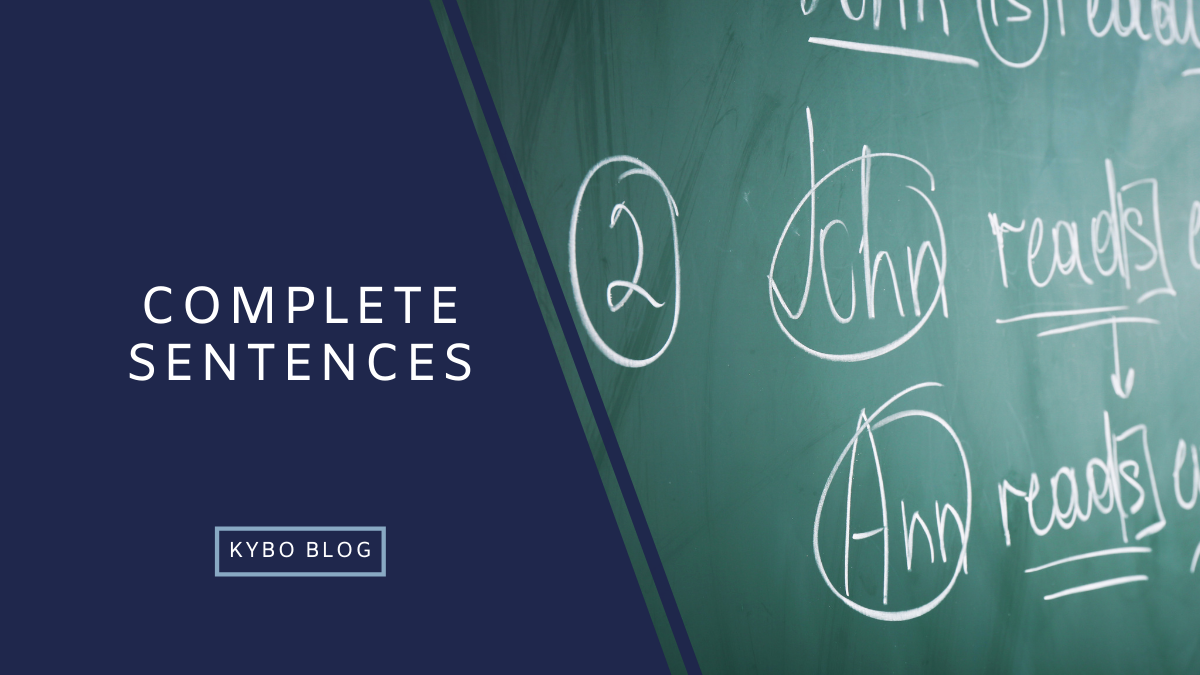
Complete Sentences
“Listen, I know what a complete sentence is.”
I know you do. We naturally start speaking in complete sentences from an early age, and we are taught to write in complete sentences not too long after. But it’s good to review what goes into a complete sentence so that you can quickly identify what a sentence is missing on grammar tests.
Identifying complete sentences is one of my most frequently used skills while taking the ACT/SAT.
The Five Requirements
A complete sentence satisfies five conditions:
- It starts with a capital letter (You won’t have to worry about this one on the test).
- It ends with a period, question mark, or exclamation point (You won’t have to worry about this either).
- It has at least one subject.
- It has at least one verb.
- It makes sense on its own.
The test makers don’t try to trick you with missing capital letters or ending punctuation, so we really only need to be concerned with two of the parts of a complete sentence: subjects and verbs.
Subjects
You already know that the subject of a sentence is a noun. You may also know that the subject answers the question “Who or what did something in the sentence?” And if I give you a simple sentence, you won’t have any issues finding its subject.
What is the subject in the following sentence?
The scythe arrived late on a cold November afternoon.
Scythe by Neal Shusterman
Who or what did something in that sentence? “The scythe” did. Easy. What if we choose a more challenging sentence?
What is the subject in the following sentence?
To construct their edible instruments, the brothers manually bore holes into the vegetables by using long metal drill bits, snacking on discarded pieces as they work.
From ACT A11 English, Passage 1
Who or what did something in that sentence? Well, now we’ve got a much longer sentence. Our subject, though, is still at the start of our independent clause. The subject of the sentence is “the brothers.”
[Advanced subject tip: The subject will never be part of an appositive or prepositional phrase.]
Verbs

The verb is, of course, the action or state of being in a sentence. The verb answers the questions “What did they (the subject) do?” or “What are they?” Again, with a simple sentence, finding a verb is easy.
What is the verb in the following sentence?
The scythe arrived late on a cold November afternoon.
Scythe by Neal Shusterman
We already know the subject is “the scythe,” so what did the scythe do? Arrived. How about the verb for our more challenging sentence?
What is the verb in the following sentence?
To construct their edible instruments, the brothers manually bore holes into the vegetables by using long metal drill bits, snacking on discarded pieces as they work.
– From ACT A11 English, Passage 1
What did the brothers do? They bore holes. You may have been fooled and answered “construct” or “snacking,” but these can’t be the verb in the sentence because they are part of either an introductory phrase1 (construct) – or an addition at the end of the sentence2 (snacking).
Let’s agree to subject/verb agree
The most obvious way to make use of your subject and verb skills is on questions about subject/verb agreement. Check out the following question, a simplified version of question 9 from the A11 ACT test.
Other factors, like the diameter of the hole and changes in air temperature and humidity, also ______ the sound quality.
A. Affects
B. Affect
To answer the question correctly, we need to identify the subject of the sentence. Many people will just look at the nearest noun, humidity, and choose “A” to agree with that. However, the actual subject of the sentence is factors, so the correct answer is “B.”
Being able to quickly find subjects and verbs will also help you identify sentence structures and know how to combine sentences – topics for a future blog.
1 To be more specific, it’s an infinitive phrase.
2 In this case, a participle phrase
Want to learn more writing tips?
Head over to this blog post! If you found this helpful, please share it with someone who may find this information useful as well.