
How to save energy on the ACT? Master the Grammar.
The ACT English section should be run on the gut. What does that mean? To put it briefly, it means that there should not be too much going through your head while taking the ACT English section.
That probably sounds strange. Won’t you be taking a test? Indeed, a very long test! Thus, the English section—the first section of the test—is the last thing that should be sapping you of energy on test day. It will be crucial that you preserve that glucose for the Reading and Science sections. Thus, you need the lowest numbers of mental operations executed throughout the English section. Rather, it should feel like one gut reaction after the next.
“The ACT English section should be run on the gut.”
– KYBO Founder Mark Hastings
Did I mention the ACT English section is 75 questions? To be completed in 45 minutes‽ Think about it: you just finished your bagel on the way into the testing center. The following sip of orange juice is supposed to carry you all the way through the next 3.5+ hours of ACT testing… right? Not if you’re wasting time running high-level comparative analyses of four “different-sounding” answers. Especially not if you’re doing that on a question that’s merely testing simple punctuation rules!
Train Your Gut
There’s simply no way around it. You need to “train your gut” to run through each 15-question English passage, quickly and confidently. Coming to expect all the most common question types, you need to spend very little time on most Conventions of Standard English questions (the grammar questions). That way, you can preserve your higher faculties for the more thought-intensive Production of Writing and Knowledge of Language questions (the rhetorical questions). These are meant to catch rushed, or generally careless, test takers off guard.

A monster example
Check out the example ACT English problem below:
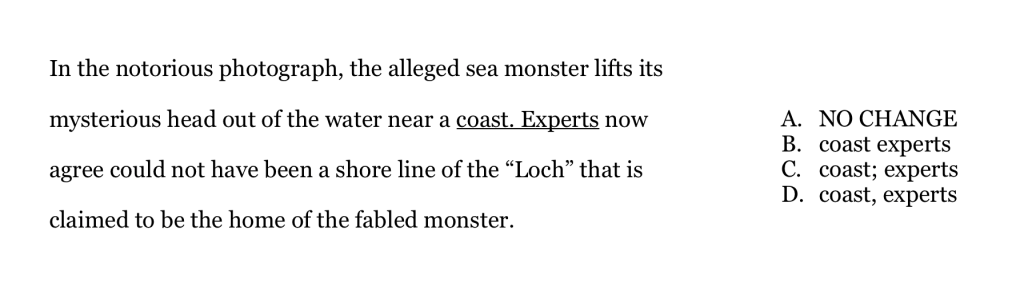
Firstly, this is a punctuation problem, which you can tell from a quick glance across the available answer choices. Because of this, you can immediately skip the introductory phrase (“In the notorious photograph”). You can also pretty much shut down your rhetorical processor. In other words, you don’t need to know “what’s going on” for a pure grammar question like this. What does that mean practically? Adjectives, adverbs, descriptive phrases in general—all can be ignored. There go over 30 syllables that were carefully crafted by the test makers to waste your time and energy.

Secondly, the simple fact that answer choices A and C both exist reveals that they are both wrong. Why? A semicolon and a period each serve the same function, so they can’t both be correct, after all. That small piece of knowledge about the conventions of standard English just got you quickly and confidently down to two viable answer choices.

To take it home, you need to realize that the phrase “experts now agree could not have been a…” is all just describing the word coast. With so many words present, it is perhaps tricky to perceive that what I just said is true. Thus, most people land on Answer Choice D because they feel like a pause sounds okay in the spot where the test maker drops a comma. What I like to do, not just for my students but for myself, is drop a “that” between coast and experts because it’s referencing “a coast that experts agree couldn’t have been the coast.”
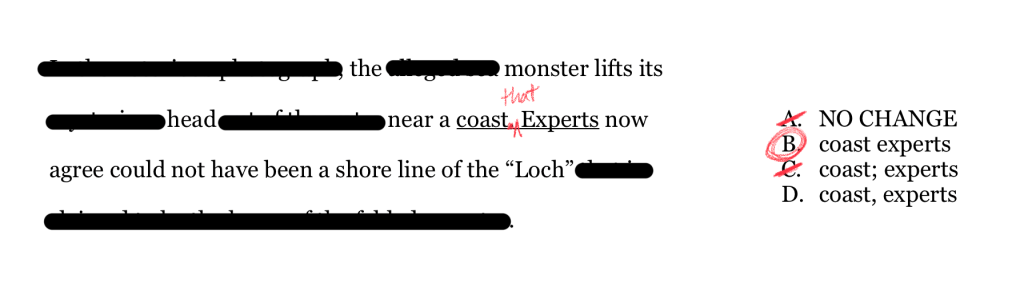
A much cheaper example
(A) The book I read last month was great.
(B) The book that I read last month was great.
See the difference between Examples A and B? Me neither. Because there is no difference. In both examples, the phrase “I read last month” is merely modifying the book. The addition of the word that merely helps the reader or listener get a bit more clarity. Are the test makers at ACT, Inc. ever trying to help you? No. You are their enemy. So start treating them like yours.
By the way, because we’re so creative, the “monster example” above was not stolen from the ACT. Rather, it was crafted in house at KYBO. That said, because we’re so cunning, the model for the question was ripped straight off of Practice Test 5 on page 760 of The Official Act Prep Guide 2020 – 2021. In the future, we’ll save such in-depth examples and solutions for KYBO subscribers; however, this time, we’ll risk the cease and desist letter from the ACT, Inc. so that you can get a taste of how we create truly “inspired” content:

For more “gut-training,” check our blog weekly!
Want to learn about punctuation you will see on the ACT?
Head over to this blog post! If you found this helpful, please share it with someone who may find this information useful as well.